Freight fraud prevention

Stop freight fraud
before the load moves.

Know who’s really behind the MC number before you book. Then keep watching the truck on the road and the money on its way out. Fraud is the enemy here. Carriers never are.

The fraud brokers fear

Seven ways you get burned. What we do about each.

A verification isn’t finished until every party has answered: owner, insurance source, dispatcher, driver. A smooth talker can’t answer for all four.

Stolen carrier identity

Caught

How it hits you

Someone takes over a real carrier’s record, changes the phone and email, and books your load. The MC checks out, because the company is real.

What we do about it

  • See the carrier’s past from day one. Phone, email and insurance changes are dated, and recent ones show as warnings.
  • We call the owner on the registered phone for a short recorded interview, then check the answers against the federal record.
  • The owner proves who they are with an ID and a selfie check, plus a one-time code.
  • Spot one person behind two carriers. The same computer on another carrier’s verification holds the file for your review. VPNs, impossible travel and links opened from the wrong place get flagged too.

Carrier vetting software

Double brokering

Caught

How it hits you

A carrier takes your load, then resells it to someone you’ve never heard of. You find out when the shipper calls, or when the real hauler wants paying.

What we do about it

  • The owner confirms or rejects the dispatcher you named. “Not recognized” is Do not book.
  • You’re warned when a dispatcher’s number was rejected by a carrier owner, on any broker’s check.
  • The driver and truck on your load are checked against the policy when it lists them.
  • In our TMS, an expired verification blocks booking. Do not book stays in the way unless a person overrides it with a written reason.
Double brokering prevention

Fake insurance

Caught

How it hits you

A real certificate with new dates, new limits or a new name. It looks like every other PDF in your inbox, and nobody checks it against anything.

What we do about it

  • We get the certificate straight from the source, not from the carrier.
  • It’s read automatically and checked against the FMCSA filing.
  • One insurance profile per carrier. Coverage gaps show at a glance, with no certificates to re-read.
  • A different company on the policy, expired coverage, liability below the federal minimum or a load value over the cargo limit is Do not book.
  • Lapsed coverage puts the carrier on hold.
Carrier insurance verification

Fake drivers

Caught

How it hits you

The carrier is real and the driver isn’t. A borrowed license, someone else’s photo, a picture of a picture. Most vetting never meets the driver at all.

What we do about it

  • The driver takes the license, VIN and selfie photos live, with the phone camera.
  • License details are matched against the state DMV record in 44 states; an MVR covers the rest.
  • The selfie is compared with the license photo, and edited photos count against the file.
  • A driver missing from the policy’s list is held for your review.

Phone swaps

Caught

How it hits you

The phone number on the record gets changed. Now every call to “the carrier” rings the fraudster, and the real owner has no idea.

What we do about it

  • We call and text the numbers this carrier used to have, oldest first, once the owner has finished.
  • A denial fails the verification.
  • A dispatcher whose phone is a number the carrier removed is Do not book.
  • Old phone numbers don’t lie.

Theft in motion

Flagged

How it hits you

The carrier checks out and the paperwork is clean. Then the wrong person turns up at the dock, or the truck isn’t where it says it is. By the time anyone calls, the freight is gone.

What we do about it

  • Load fraud flags catch the wrong phone, an internet-calling number, a faked location and a truck far from pickup.
  • We hold back the pickup number until the verified driver’s phone is tracking. You can release it by hand.
  • Send the shipper a driver and truck card, so they know who’s coming.
  • Red flags surface first in Needs attention, along with dark trucks, no-shows and late assignments.

Payment-redirect fraud

Held

How it hits you

An email says the carrier changed banks. Someone updates the file. The next payment goes to the fraudster, and the real carrier still wants paying.

What we do about it

  • A change to a carrier’s pay details from your team waits for a company admin to approve.
  • Until then, the details on file stay in use.
  • You can see who asked for each change, and what it was before and after.
Semi truck with its lights on, on an open road at dusk
Before pickup

The time to find out who’s really hauling your load is before it leaves the dock.

What stops a booking

Any one of these is Do not book.

A good score can’t average them away. A person can override one, but only with a written reason.

  • The insurance has expiredDo not book
  • The insured is a different companyDo not book
  • Liability is below the federal minimumDo not book
  • The declared load value is over the cargo limitDo not book
  • FMCSA says not allowed to operate, or out of serviceDo not book
  • An adverse FMCSA change in the last 7 daysDo not book
  • The owner says “not my company”Do not book
  • The owner doesn’t recognize the dispatcherDo not book
  • An old phone number denies the changeDo not book
  • The dispatcher’s phone is a number the carrier removedDo not book
  • Paper truck: the VIN decodes as a carDo not book
  • Three or more unusable photos, or two or more edited or non-camera photosDo not book

Blocked until it’s fixed

An expired verification blocks booking until you re-verify. FMCSA “not allowed to operate” blocks every booking.

On hold

Lapsed coverage puts the carrier on hold. Booking anyway takes a written reason, and the hold lifts once coverage is back on file.

Held for your review

A VPN, the same computer on another carrier’s verification, a driver missing from the policy’s list, or a spoken owner name that matches nothing on file. A reason to pick up the phone, not a verdict.

On your screen

What it looks like when we catch one.

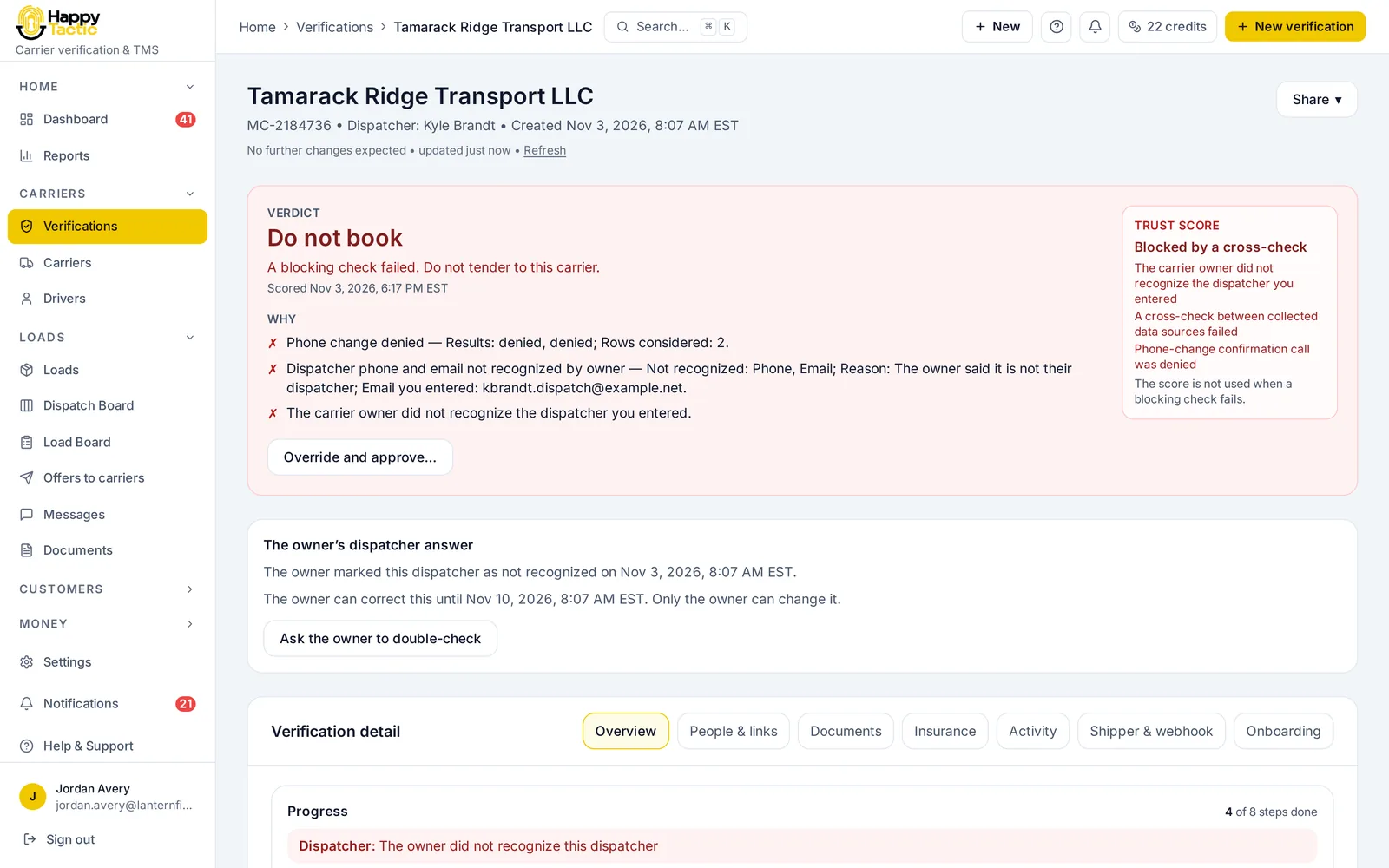
Verification page showing a red Do not book verdict: the carrier owner did not recognize the dispatcher, with an Override and approve button
A blocking check failed: the owner did not recognize the dispatcher. Sample data.

The verdict says why.

The finding that stopped the file is listed in plain words. If you override it, you write down the reason.

You keep the proof.

The decision email carries the evidence PDF. Send it to a shipper, or keep it for a claim.

30 seconds: a perfect interview, then the number that left the record. Fictional carriers and data.
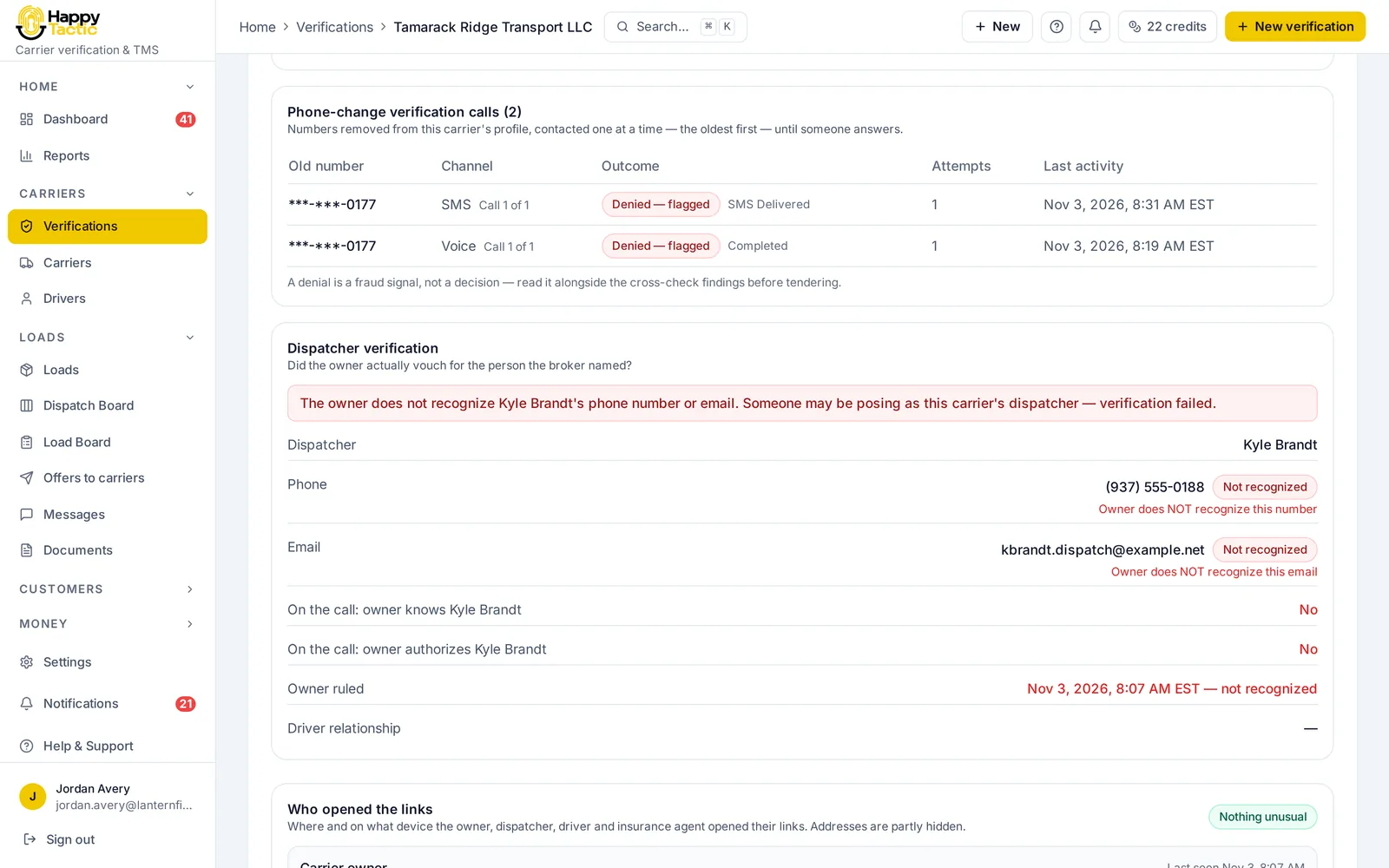
Phone-change verification table: a removed number contacted by text and by voice, both marked Denied and flagged, above the owner's not recognized answer on the named dispatcher
A removed number, contacted by text and by voice. Both answers: denied. Sample data.

Old numbers, oldest first.

One at a time, once the owner has finished. A denial fails the verification.

A rejected number stays flagged.

A dispatcher number an owner rejected gets flagged on your other verifications.

Questions brokers ask

Answers about freight fraud.

What’s the most common carrier fraud scheme right now?

Stolen carrier identity: a real carrier’s record with quietly changed contact details. The MC checks out, the authority is active, and every call goes to the fraudster. A one-time lookup sees nothing wrong. A change history shows you the fresh phone number on an old authority right away.

What if the fraudster controls the carrier’s registered phone number?

Then a phone call alone proves nothing, so a perfect interview can’t clear a carrier here. Insurance counts for the most, and we get the certificate straight from the source, not from the carrier. We also call and text the numbers the carrier used to have. Whoever used to answer them is the person a fraudster least wants us to reach.

How do you catch theft once the load is moving?

Load fraud flags watch the phone that’s tracking. A phone that isn’t the verified driver’s, an internet-calling number, a faked location or a truck far from pickup raises a red flag on the load and in Needs attention. The driver doesn’t see the pickup number until the verified phone is tracking, unless you release it by hand.

What is payment-redirect fraud?

Someone posing as a carrier or its factor asks you to send payment to a new bank account. Once the change goes through, your money is gone and the real carrier is still unpaid. In Happy Tactic, a change to a carrier’s pay details from your team waits for a company admin to approve, and the details on file stay in use until then.

Is OK to book a guarantee?

No. A verification is evidence and a decision, never a guarantee or insurance. It catches what one-time checks miss, then keeps watching: verified carriers are re-checked about every five minutes, adverse changes send an alert, and verifications expire after 30 days by default, sooner if the insurance runs out.

Is a VPN or a shared computer an automatic fail?

No. A VPN is a small score deduction and a review flag. The same computer used on another carrier’s verification holds the file for your review. Both are reasons to look, not verdicts.

What if an owner rejects their own dispatcher by accident?

People tap the wrong button. The owner can press “I made a mistake” and correct the answer once, within 7 days, after a new one-time code. Old-number calls wait 10 minutes, so a slip can be taken back first. The earlier answer stays in the history.

What happens if fraud gets through anyway?

You have the records for the claim. The evidence PDF lists every finding, and verification records stay on file. Mark the outcome on the verification, and our scoring model learns from it.

Will this slow down good carriers?

No. Carriers are the first victims of most of these schemes. An honest carrier clears in minutes, not days, when everyone does their part: a short recorded call, a one-time code, photos from the driver, and no account or password to create. Everything runs on secure links.

Stop the next bad load before it moves.

A demo is a call with a founder. Bring the carrier you’re least sure about.