Know who’s really behind the MC number.
Type one number: we reach the owner, get the insurance straight from the source, confirm the dispatcher and identify the driver, and you get a clear answer.
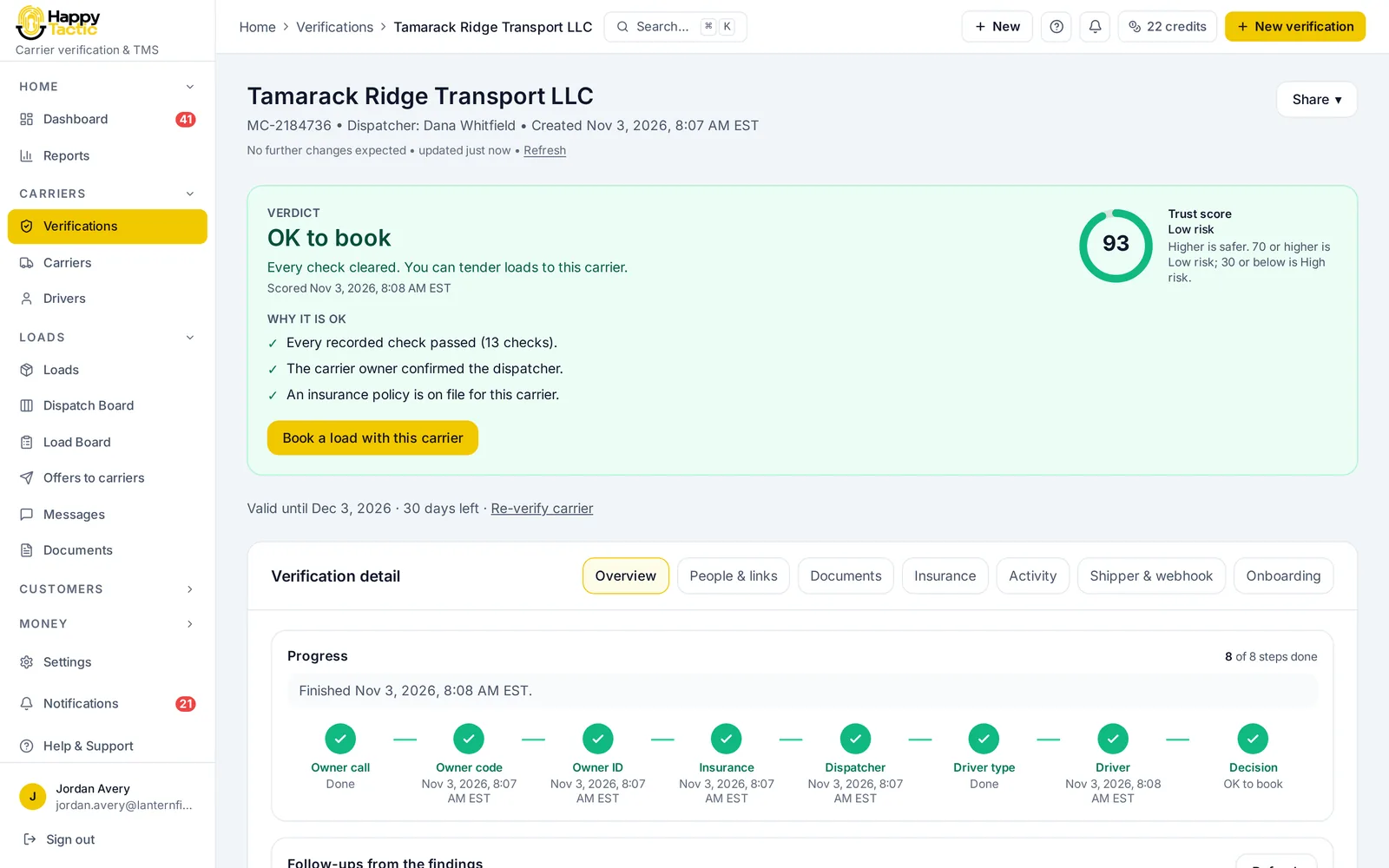
- Owner confirmedReached on the phone on record
- Insurance from the sourceNot from the carrier
- Dispatcher confirmedBy the owner, by name
- Driver matchedLicense, selfie and truck
What we check
Everything you’d check yourself, if you had all day.
About 40 cross-checks sit behind one plain answer. Here’s what you get, and what it catches.
Carrier history
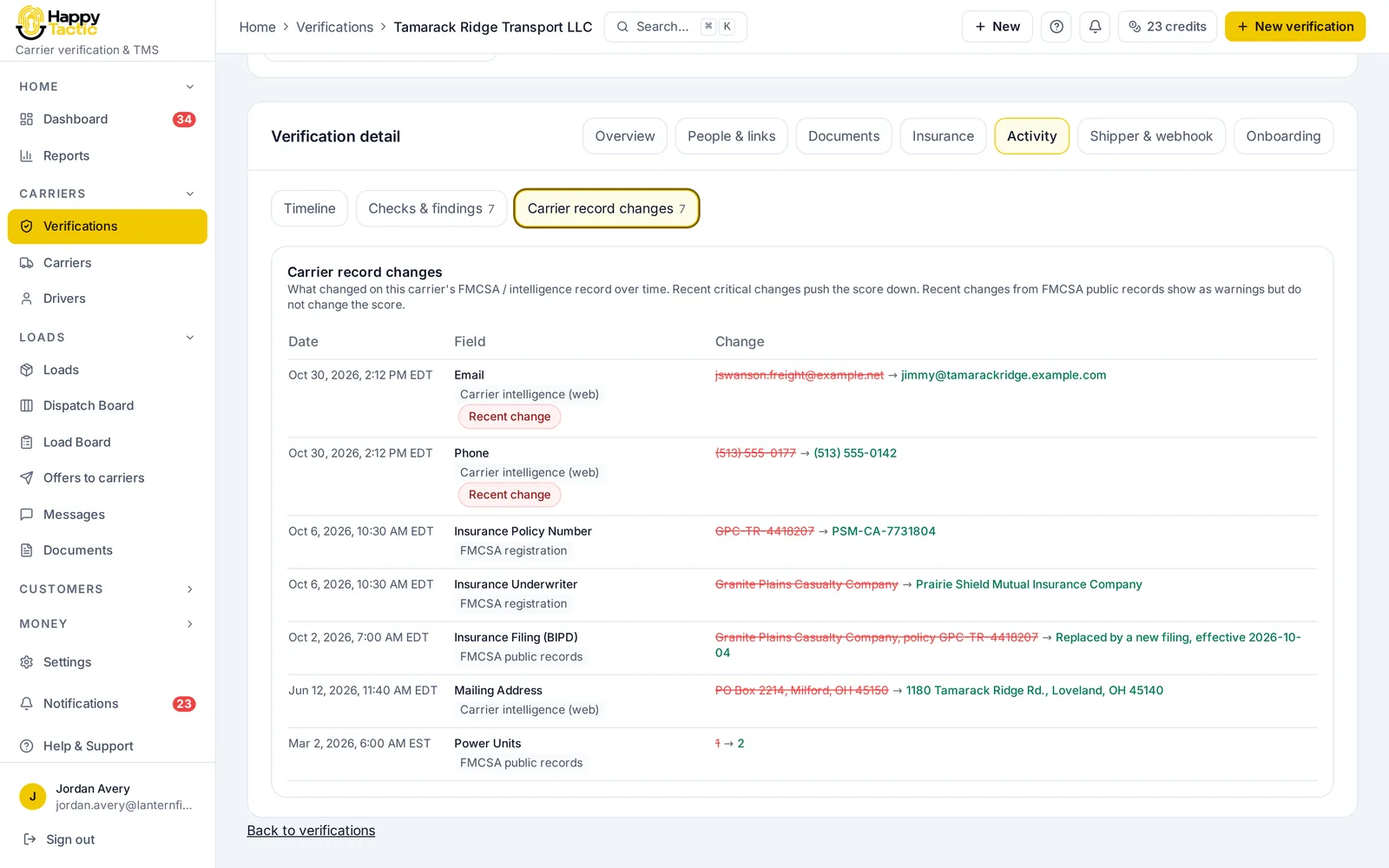
See what changed, not just what’s on file
A carrier that swapped its phone, email and insurer last month can look spotless today. A snapshot won’t show you that.
You see a carrier’s past from day one, from FMCSA public-record history and a nationwide database of about 4.5M carriers, refreshed nightly. Recent changes show up as warnings.
The owner
We talk to the owner
We call the owner on the phone on record. It’s a short recorded interview, and the answers are checked against the federal record.
Then a one-time code and a photo ID with a selfie. A returning owner only needs the selfie. No account, no password, English or Spanish.
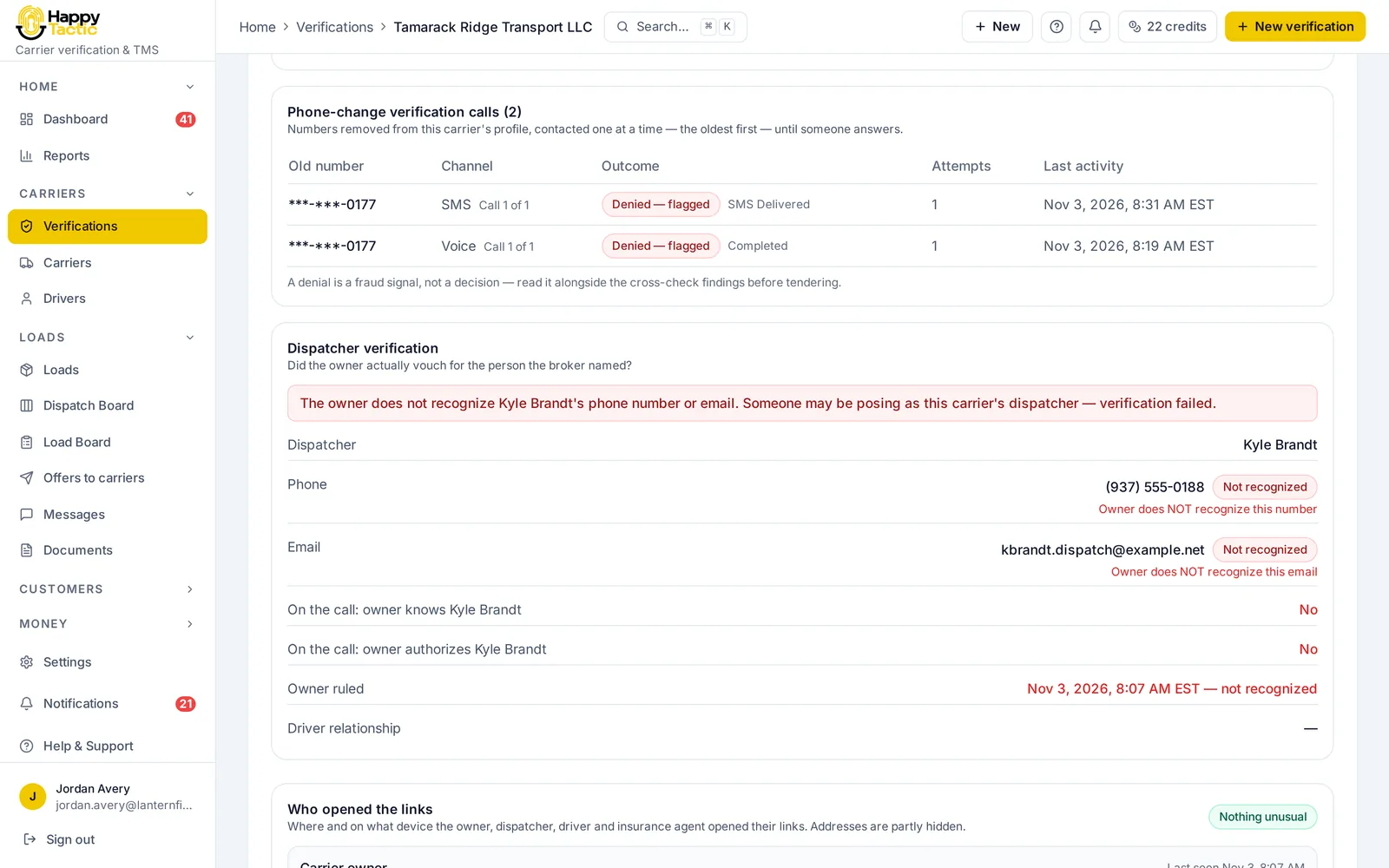
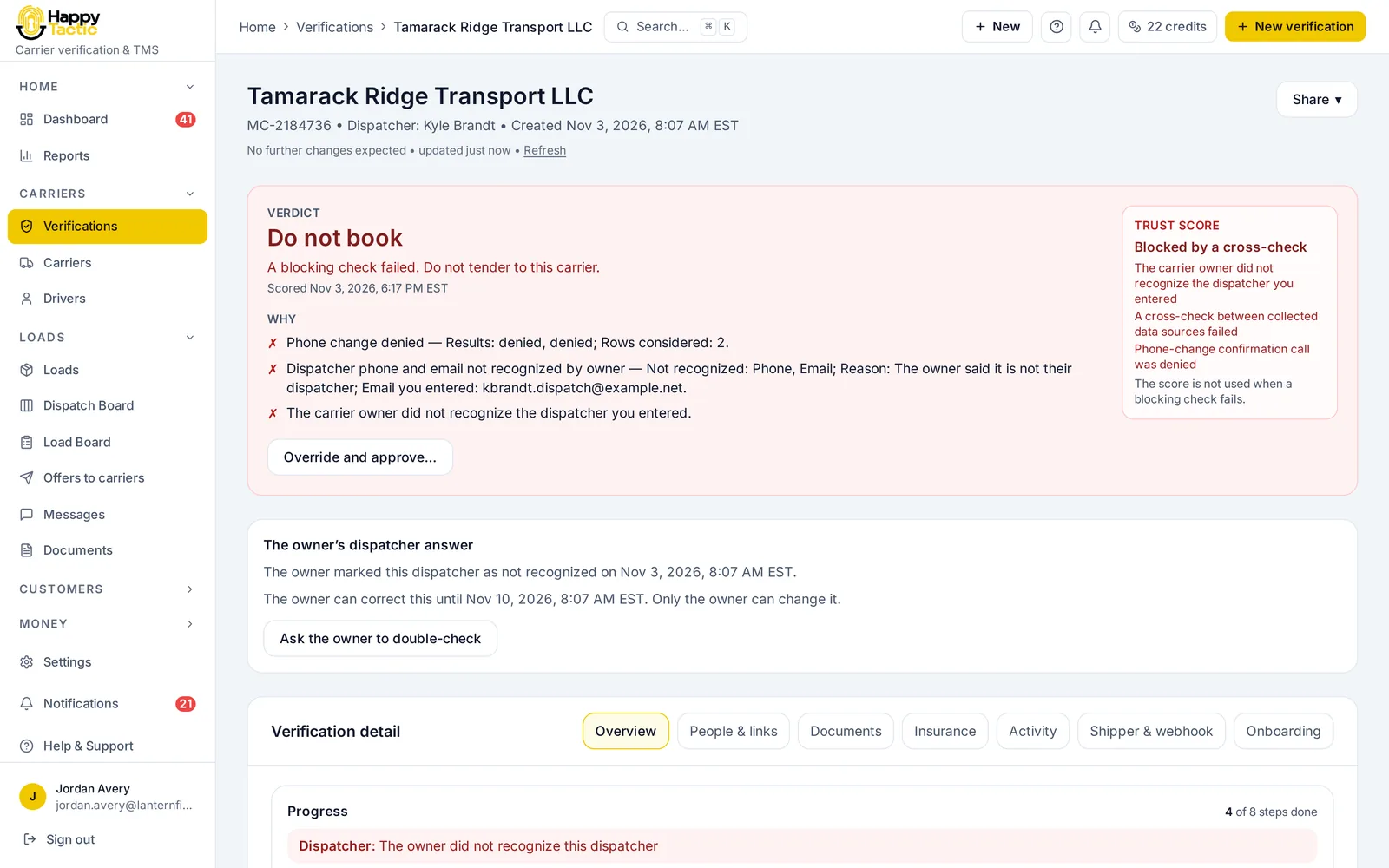
The owner also confirms or rejects the dispatcher you named. “Not recognized” is Do not book.
One-truck carrier? Owner-operators get their own path, with no dispatcher to name.
Sample carrier.
Old numbers
Old phone numbers don’t lie
Someone who takes over a carrier’s record controls the phone on file. They don’t control the numbers it used to have.
So once the owner has finished, we call and text those old numbers, one at a time, oldest first. Toll-free numbers get a call. If the person who used to answer says no, the verdict is Do not book.
Insurance
Insurance straight from the source
Emailed certificates are the easiest paper in freight to fake. So we get the certificate straight from the source, not from the carrier.
It’s read automatically and checked against the FMCSA filing. You get one insurance profile per carrier, so coverage gaps show at a glance and nobody re-reads certificates.
If coverage lapses, the carrier goes on hold. Booking anyway takes a written reason.
Sample carrier. VINs and drivers appear when the policy lists them.
Driver and truck
The real driver and the real truck
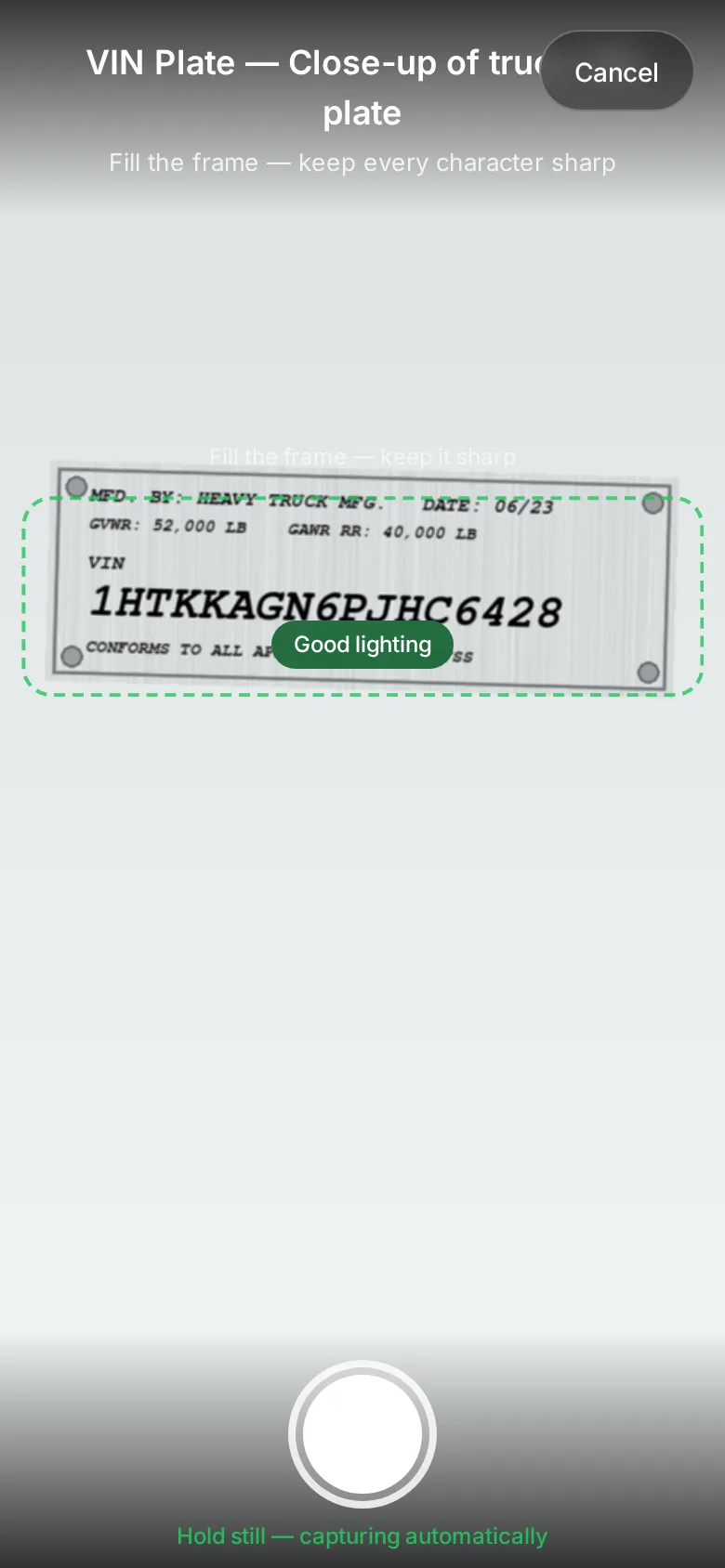
We text the driver a link, in English or Spanish. It opens the camera, so the photos are taken live: selfie with ID, license front and back, VIN plate, and the truck.
License details are matched against the state DMV record in 44 states; an MVR covers the rest. You can also run an MVR on any verification. A face match and a liveness check confirm the selfie.
The VIN is checked against the policy. A VIN that decodes as a car is a paper truck, and that’s Do not book.
More drivers? Add them to a valid verification, or check a driver on its own.
Small tells
And the things you’d never catch by hand
One person behind two carriers
If the same computer shows up on another carrier’s verification, the file is held for your review.
VPNs, impossible travel, wrong-place links
An owner on a VPN. Two visits too far apart to travel between. A link opened from the wrong place. You see it on the file.
Dispatcher numbers owners rejected
If a carrier’s owner rejected that dispatcher’s number on any broker’s check, you get a warning.
The answer
One clear answer, with proof
All of it comes down to three words and a score from 0 to 100, higher is safer. The score stays hidden until the checks finish.
- OK TO BOOK70 or above, unless something holds the file
- NEEDS YOUR REVIEWIn between. You read why and you decide
- DO NOT BOOK30 or below, or anything on the list below
The decision email carries the evidence PDF: the verdict, the reasons, and what to check at pickup. Send it to a shipper or keep it with a claim.
An OK to book can send your carrier contract automatically, and the signed contract creates the carrier in your TMS. Nothing re-typed.
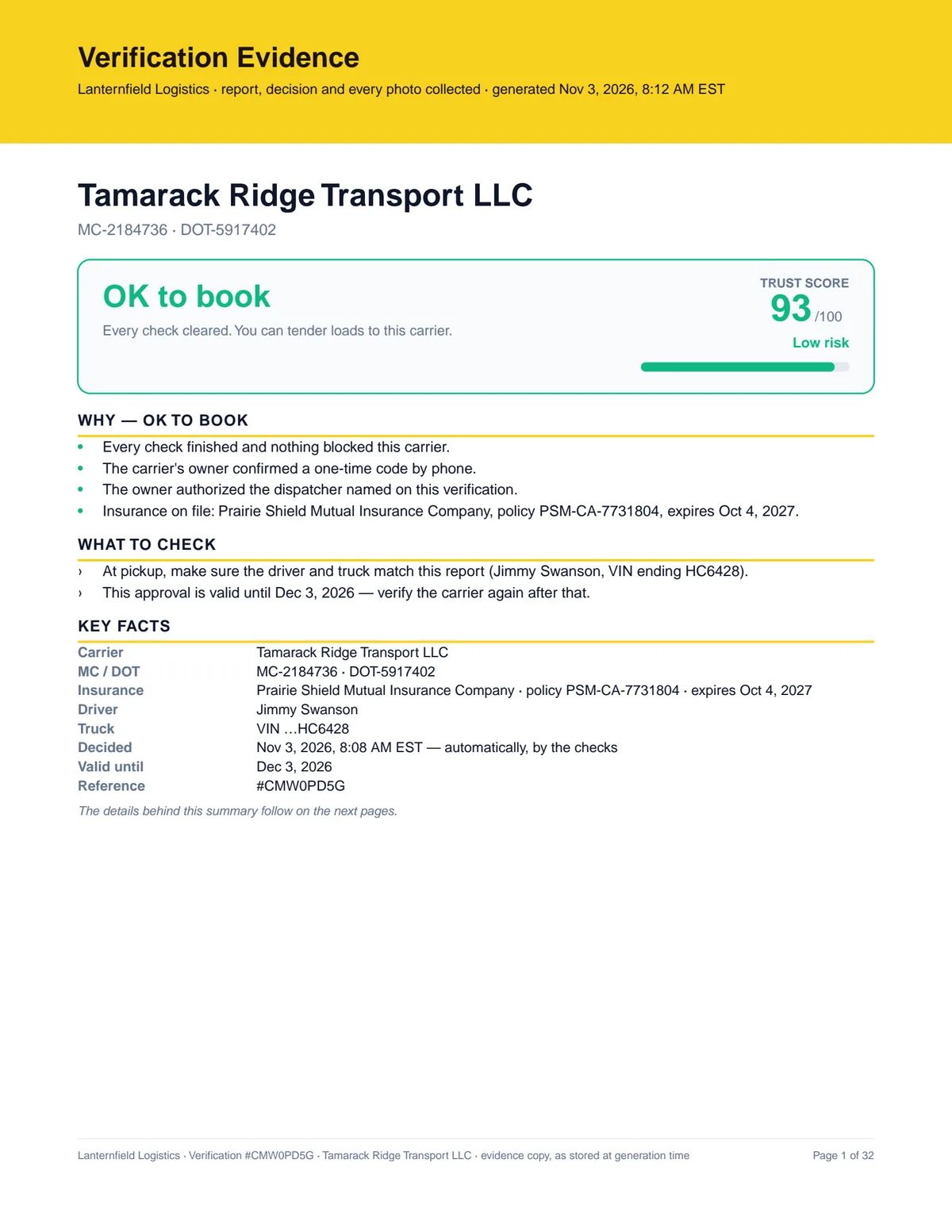

Live photos, matched to the license, the policy and the truck.
Do not book
What stops a booking
No judgment calls on these. Any one of them is Do not book, whatever the score says.
Do not book
- The insurance has expired
- The policy is in another company’s name
- Liability is below the federal minimum
- The load’s declared value is over the cargo limit
- FMCSA says “not allowed to operate” or out of service
- A bad FMCSA change in the last 7 days
- The owner says “not my company”
- The owner doesn’t recognize the dispatcher
- An old phone number denies the change
- The dispatcher’s phone is a number the carrier removed
- A paper truck: the VIN decodes as a car
- 3 or more unusable documents, or 2 or more edited or non-camera photos
A person can override a Do not book with a written reason. An expired verification and FMCSA “not allowed to operate” block booking outright.
Held for your review
- Operating authority under 90 days old
- A driver who isn’t on the policy’s named-driver list
- An owner name on the call that matches nothing on file
- A VPN, which also takes a little off the score
- The same computer used on another carrier’s verification
After the answer
It keeps watching
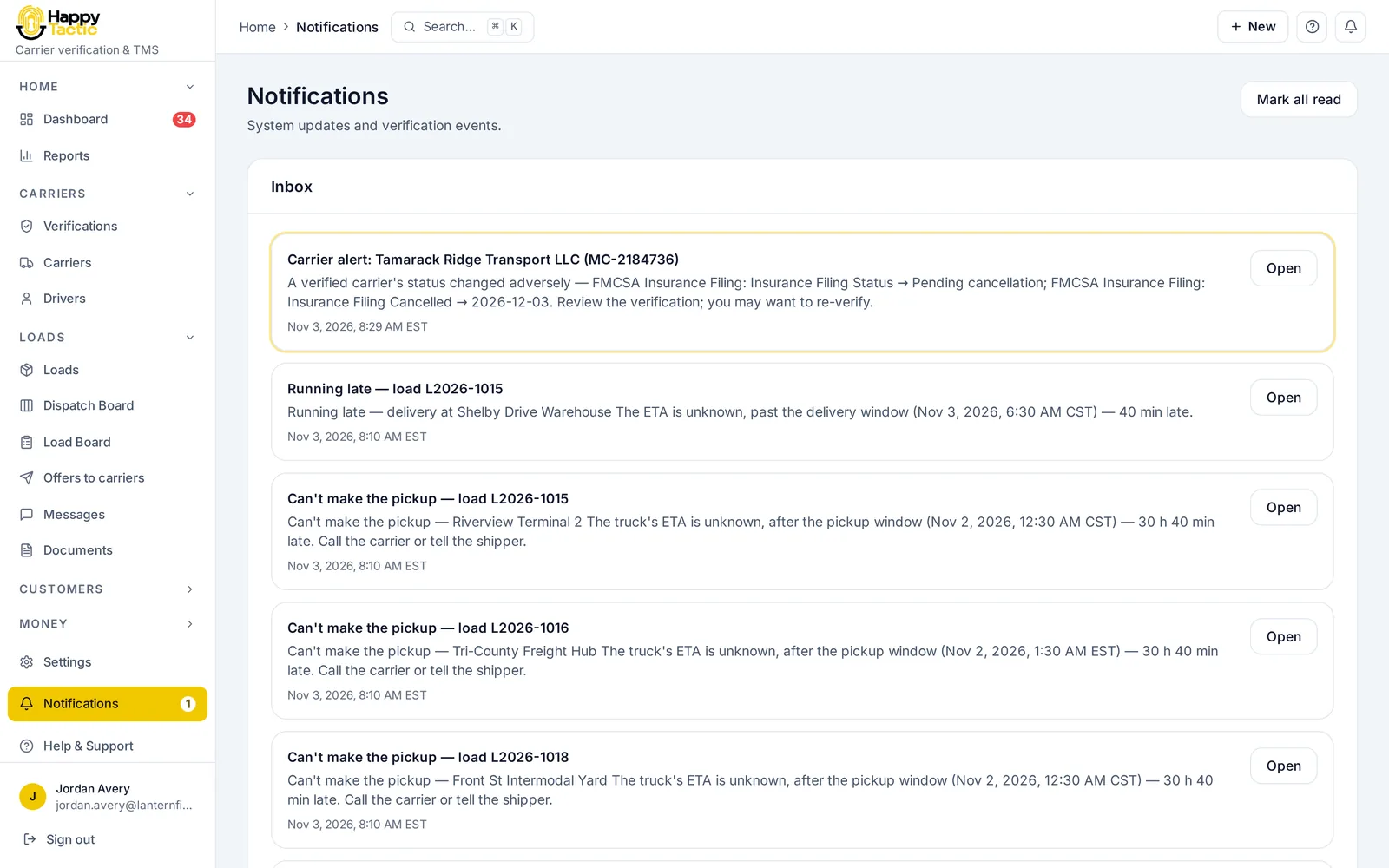
Every verified carrier is re-checked about every five minutes. If its authority, out-of-service status or insurance takes a bad turn, you get an alert.
- Lapsed coverage. The carrier goes on hold until coverage is back on file.
- Expiry. Warnings at 14 and 7 days. An expired verification blocks booking until you re-verify.
- Faster re-verify. For a known carrier: a code, a selfie, and the results you already have.
Questions
What brokers ask us.
What do I need to start a verification?
An MC or DOT number, the owner’s contact details as you have them, the dispatcher you deal with, and the declared value. We take it from there. Your part is reading the answer.
How long does it take?
When people answer, it runs in minutes, not days. A verification isn’t finished until every party has answered: owner, insurance source, dispatcher, driver. Until then the score stays hidden, so nobody books on half a file.
What if the owner doesn’t pick up?
A text goes out, we redial at five minutes and again at ten, and if it still fails you’re alerted. You don’t have to chase anyone yourself.
Can I still book a carrier that gets Do not book?
A person at your company can override it with a written reason. Two things block booking outright: an expired verification, until you re-verify, and FMCSA “not allowed to operate”.
What if the owner rejects the dispatcher by mistake?
The verdict goes to Do not book right away. The owner then has an “I made a mistake” correction: 10 minutes before any old-number calls start, and one correction within 7 days. Only the owner can make it.
How long does a verification stay valid?
30 days by default, 7 to 60 if your company changes it, or until the insurance expires, whichever comes first. You get warnings at 14 and 7 days. Re-verifying a known carrier is faster: a code, a selfie, and the results you already have.
Can I check one driver without verifying a carrier?
Yes. Check a driver runs on its own from the Drivers page. We text the driver a link, they photograph their license and take a selfie, and you get OK to use, Needs your review, or Do not use. You can also add extra drivers to a valid verification.
Bring us the carrier you’re not sure about.
Book a demo with a founder and see what comes back: the history, the calls, the certificate, the answer.