Fraud prevention · Double brokering
Double brokering prevention that starts before the tender.
A double-brokered load looks fine until the wrong truck shows up, or the real hauler calls you about payment. Know who is behind the MC number, who is allowed to dispatch for them, and who is actually driving, before the load moves.
How it works
How double brokering actually happens
Most double brokering doesn’t look like fraud on day one. It looks like an available carrier with a clean MC number and a good rate. The steps are simple, which is why they keep working.
- The identity. Someone uses a real carrier’s authority, sometimes after changing the phone and email on its federal record, sometimes by just using a look-alike email address.
- The booking. They answer your load, send a certificate of insurance and sign your packet. Every document checks out because every document was prepared for you.
- The hand-off. The load gets re-posted for less, and a real driver who has no idea what’s happening picks it up.
- The money. You pay the party you booked. The driver who moved the freight doesn’t get paid and comes looking, or the freight disappears altogether.
A lookup of the MC number catches none of this, because the record belongs to a real company. The question to answer isn’t “is this carrier authorized?” It’s “am I actually talking to them, and are they the ones hauling my load?”

If the truck at your dock isn’t the truck on the policy, you want to know before it’s loaded.
The checks
Where each hand-off gets caught
The carrier’s history, not just today’s record
A carrier that changed its phone, email and insurance three weeks ago looks healthy in a point-in-time check. Its change history shows the pattern first, and recent FMCSA public-record changes show as warnings.
The numbers it used to have
We call and text the numbers this carrier used to have, oldest first, once the owner has finished. The person who used to own that number is the one a fraudster least wants reached. Old phone numbers don’t lie.
The owner, on the number of record
A short recorded interview with spoken answers checked against the federal record, then a code sent only to the registered contact.
The dispatcher, named and authorized
The owner confirms or rejects the dispatcher you named, and signs for the one they confirm. “Not recognized” is Do not book, and a rejected number gets flagged on your other verifications.
The driver and truck on the load
Camera-only license and VIN captures. License details are matched against the state DMV record in 44 states; an MVR covers the rest. Drivers and VINs are checked against the policy when it lists them.
The pickup number, held back
We hold back the pickup number until the verified driver’s phone is tracking. You can release it by hand.
A driver and truck card for the shipper
Send the shipper a driver and truck card, so they know who’s coming.
The load itself, once it moves
The driver gets a tracking link by text at dispatch. Load fraud flags catch the wrong phone, an internet-calling number, a faked location and a truck far from pickup.
On your screen
What the mismatch looks like
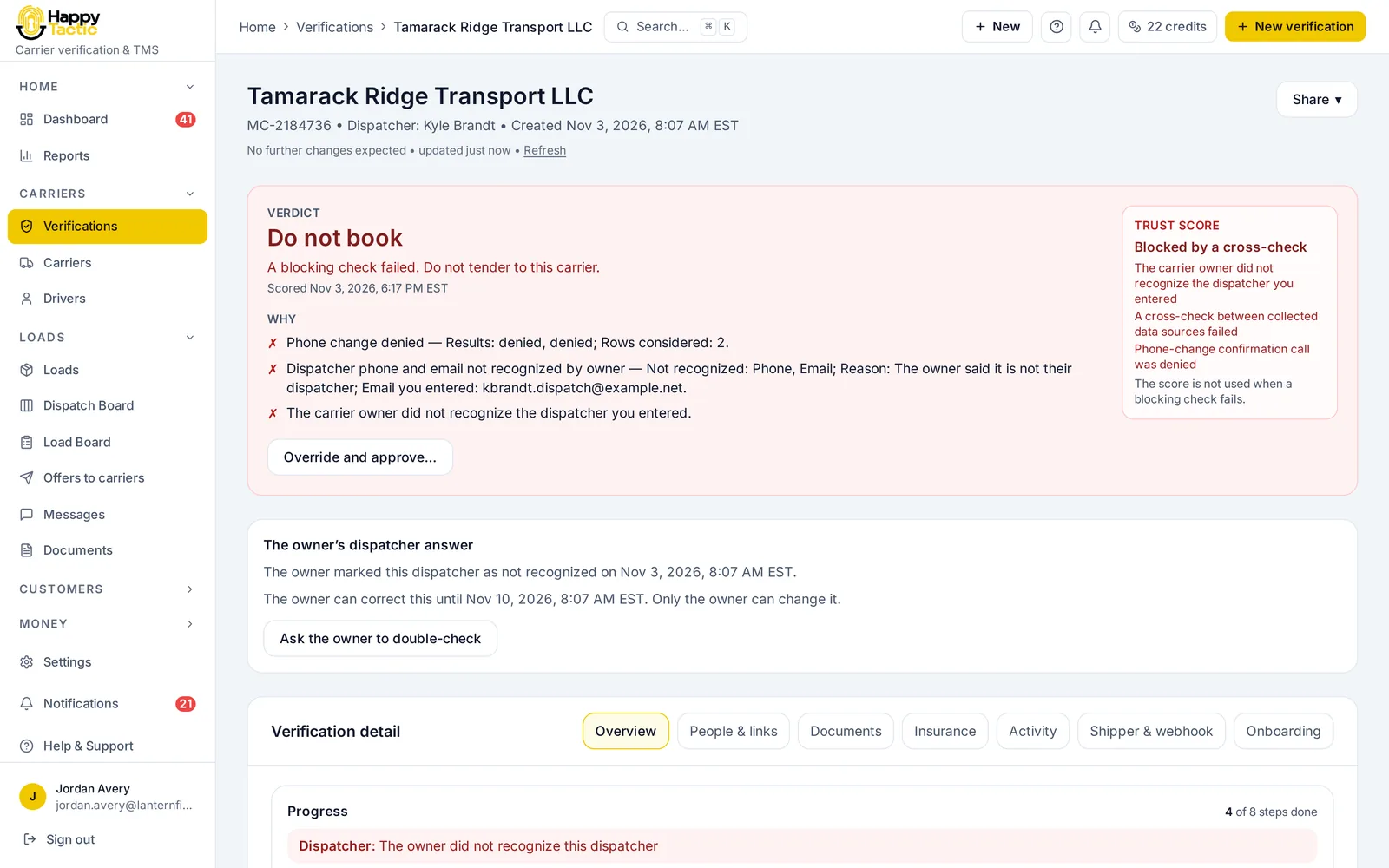
The name that answered your load email isn’t someone the owner knows. You see that before the tender goes out, along with the finding that caused it.
If the owner made an honest slip, they can press “I made a mistake” and correct it once, within 7 days. If you decide to book anyway, you write down why.
The difference
An MC lookup vs. a file
| Question | MC lookup and a COI | Happy Tactic |
|---|---|---|
| Is the authority active? | Yes, it’s a real company | Yes, plus how the record changed over time |
| Am I talking to the real carrier? | Unknown | Recorded owner call, code to the registered contact |
| Who can accept this load? | Whoever answered the email | The dispatcher the owner confirmed in writing |
| Is the insurance real? | A PDF someone sent you | Certificate straight from the source |
| Who is driving? | You find out at the dock | Identified before dispatch, checked against the policy when it lists drivers |
| Who gets the pickup number? | Whoever has the paperwork | Held back until the verified driver’s phone is tracking |
Questions brokers ask
Straight answers.
What is double brokering?
Double brokering is when a carrier or broker accepts a load and then hands it to another party without the permission of the shipper or original broker. The original broker believes one company is hauling the freight while a different one is. It is often paired with a stolen carrier identity, and the party who took the load may collect payment while the real hauler goes unpaid.
What is the difference between double brokering and co-brokering?
Permission and disclosure. Co-brokering is two licensed brokers openly working together on a load, with the customer’s knowledge. Double brokering is a hidden hand-off, usually in breach of the carrier agreement.
Is double brokering illegal?
Brokering freight requires broker authority and a bond. Federal law, 49 U.S.C. § 14916, makes unauthorized brokerage unlawful and provides for civil penalties and damages. A hidden hand-off will also usually breach the contract. Ask your attorney how this applies to a specific situation.
How do I prevent double brokering?
Confirm you are dealing with the real carrier rather than someone using its MC number. Verify the owner through the phone number of public record, get the certificate from the source rather than from the carrier, confirm the dispatcher is authorized, identify the actual driver and truck before pickup, and track the load directly with the driver.
Can software stop double brokering completely?
No. Nothing can guarantee that. What software can do is remove the easy routes: a borrowed identity, a doctored certificate, an unknown driver showing up at the dock. Happy Tactic is built to surface those mismatches before the load moves.
How do I stop the wrong driver picking up my load?
Identify the driver before dispatch, then hold back the pickup number until that driver’s verified phone is tracking. Happy Tactic also flags a phone that isn’t the verified driver’s, and lets you send the shipper a driver and truck card so the dock knows who to expect.
What are the red flags of double brokering?
Contact details that changed recently, an email domain that doesn’t match the carrier, pressure to skip your process, a driver or truck that doesn’t match what you were told, a last-minute driver change, a rate well below the market, and requests to change payment details.
Find out who’s really behind the MC number.
Type the number. We handle the calls, the codes, the insurance source and the driver, and you get a verdict with its evidence.